Bitcoin White Paper Published: The Event That Started Bitcoin
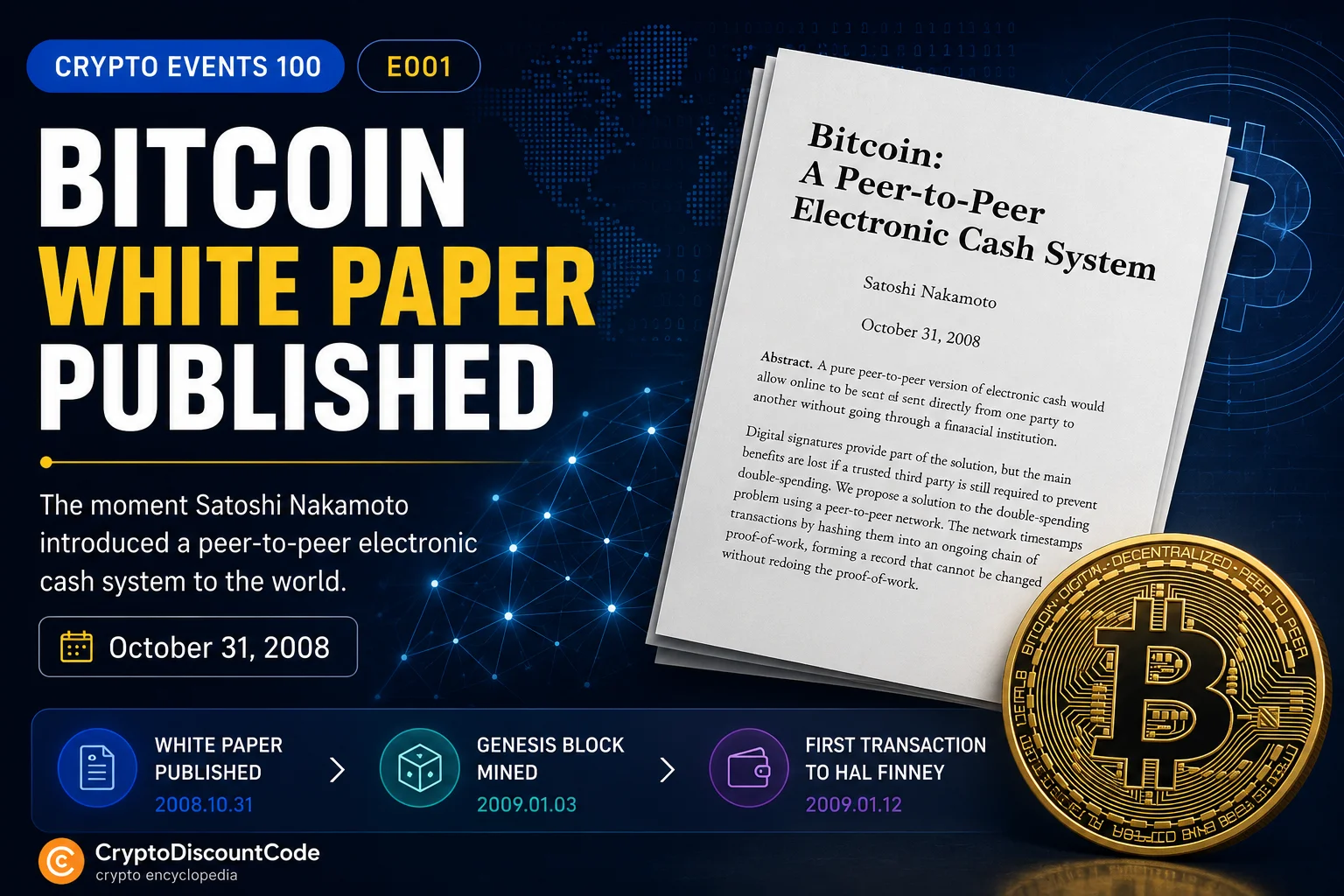
On October 31, 2008, Satoshi Nakamoto published the Bitcoin white paper, introducing a peer-to-peer electronic cash system that would become the foundation of Bitcoin, blockchain, and the modern cryptocurrency industry.
Quick Facts
What Happened?
The publication of the Bitcoin white paper was the moment when Bitcoin first appeared as a clear technical proposal. Satoshi Nakamoto sent a short message to a cryptography mailing list and introduced a paper titled “Bitcoin: A Peer-to-Peer Electronic Cash System.”
The paper described a system for sending online payments directly from one party to another without going through a financial institution. This was a radical idea because digital money had traditionally required a trusted third party to prevent double spending.
In simple terms, the Bitcoin white paper proposed a way for strangers on the internet to agree on who owns what, without needing a bank, payment processor, or central database. That idea became the foundation of Bitcoin.
Why the Bitcoin White Paper Was Important
The white paper mattered because it combined several existing ideas into a working design. Cryptographers and computer scientists had already explored digital cash, proof-of-work, peer-to-peer networks, and public-key cryptography. But before Bitcoin, no system had successfully combined these pieces into a decentralized monetary network that could operate in the real world.
Satoshi’s design addressed the double-spending problem by using a public chain of proof-of-work. Instead of asking a central server to decide which transaction came first, Bitcoin allowed the network to follow the longest valid chain produced by miners.
This was not just a technical proposal. It was also a new way to think about trust. Bitcoin shifted trust away from institutions and toward open-source code, cryptographic verification, economic incentives, and distributed consensus.
The Historical Background
To understand why the Bitcoin white paper was so powerful, it helps to remember the environment of 2008. The global financial crisis had shaken public confidence in banks, credit markets, and central financial institutions. Many people were questioning whether the existing financial system was too centralized, too opaque, and too dependent on trusted intermediaries.
Bitcoin did not appear in a vacuum. It was influenced by decades of research and experimentation in cryptography, privacy, digital cash, and internet-native money. The cypherpunk movement had long argued that cryptography could protect individual freedom in the digital age.
Earlier projects such as DigiCash, Hashcash, b-money, Bit Gold, and RPoW explored pieces of the puzzle. Some focused on privacy. Others focused on proof-of-work, scarcity, or decentralized settlement. Bitcoin’s breakthrough was to combine those ideas into a system that anyone could run, verify, and join.
Timeline Before and After the White Paper
Why October 31, 2008 Matters
The date October 31, 2008 is now remembered as one of the most important dates in cryptocurrency history. It was not the day Bitcoin began running as a live network, but it was the day Bitcoin was publicly introduced as an idea.
This distinction matters. The white paper was the blueprint. The software and the genesis block came later. Without the white paper, Bitcoin would have had no public technical explanation, no conceptual foundation, and no starting point for discussion among early developers.
For many Bitcoin supporters, the timing is symbolic. The white paper appeared during a period of financial instability and introduced a system that did not rely on banks or governments to process transactions.
What the Bitcoin White Paper Explained
The Bitcoin white paper is surprisingly short, but it introduced several ideas that changed the future of digital finance. Its central goal was simple: create a form of electronic cash that could move directly between users without relying on a trusted financial institution.
The paper explained why ordinary online payments depend heavily on trust. Credit card networks, banks, and payment companies can reverse transactions, block accounts, and act as intermediaries. Satoshi wanted a system where final settlement could happen through cryptographic proof rather than institutional approval.
Peer-to-peer payments
Bitcoin was designed as a peer-to-peer system. This means users could send value directly to each other over the internet. The network itself would verify and record transactions, rather than depending on a central company.
Proof-of-work
Proof-of-work made it costly to rewrite the history of transactions. Miners had to spend computing power to create valid blocks. This cost helped protect the network from attackers and gave honest participants a reason to follow the rules.
The chain of blocks
Transactions were grouped into blocks. Each block referenced the previous block, creating a chronological chain. This structure made Bitcoin’s ledger difficult to alter because changing one past block would require redoing the proof-of-work for that block and every block after it.
Decentralized consensus
The white paper proposed that nodes should accept the longest valid chain as the correct history. In practice, this allowed the network to reach agreement without a central administrator.
The Double-Spending Problem
The double-spending problem is one of the most important problems in digital money. A physical cash note cannot easily be spent twice because once you hand it to someone, you no longer have it. But digital files can be copied. Without a reliable system, the same digital coin could be sent to two different people.
Before Bitcoin, the usual solution was a central authority. A bank or payment processor would keep the official ledger and decide which transaction was valid. Bitcoin replaced that central ledger with a public, distributed ledger maintained by nodes and miners.
This was the breakthrough. Bitcoin did not eliminate trust completely, but it reduced the need to trust a single institution. Users could verify the rules themselves by running software and checking the blockchain.
Core Innovations Introduced by the White Paper
The Bitcoin white paper did not invent every component from scratch. Instead, it combined existing technologies in a new way. That combination was the innovation.
1. A public transaction history
Bitcoin transactions are recorded in a public ledger. Anyone can inspect the chain and verify that coins have not been spent twice. This transparency is one reason Bitcoin can function without a central accountant.
2. Miners as economic participants
Miners secure the network by creating blocks. In return, they can receive newly issued bitcoin and transaction fees. This reward system gives miners an economic reason to support the network honestly.
3. Difficulty adjustment
Bitcoin adjusts mining difficulty so that blocks are produced at a relatively stable pace over time. This helps the system remain predictable even as total mining power changes.
4. Limited supply logic
While the white paper focused mainly on the payment system, Bitcoin’s software later implemented a fixed issuance schedule and a maximum supply of 21 million coins. This scarcity became one of Bitcoin’s most important economic features.
How People Reacted at First
The first reaction to the Bitcoin white paper was not global excitement. It was a small discussion among cryptographers, developers, and digital cash enthusiasts. Some people were curious, while others were skeptical.
This is important because Bitcoin did not begin as a polished corporate product. It began as an open-source experiment shared with a technical community. Early participants examined the idea, asked questions, ran the software, and gradually helped the network grow.
The quiet beginning is one reason Bitcoin’s origin story is so unusual. There was no initial coin offering, no venture-backed launch campaign, no celebrity founder, and no central company promising returns. There was simply a paper, then software, then a network.
Long-Term Impact
The publication of the Bitcoin white paper eventually led to the creation of a global cryptocurrency industry. Bitcoin inspired exchanges, wallets, mining businesses, payment services, custody companies, blockchain analytics, decentralized finance, stablecoins, NFTs, and thousands of other crypto assets.
More importantly, it introduced a new category of financial infrastructure: a network that can be operated by people around the world without a single controlling entity. This idea continues to influence technology, economics, regulation, and political debates.
Impact on money
Bitcoin made it possible to discuss money as open-source software. For the first time, a global monetary asset could be issued and transferred by a protocol rather than a government or company.
Impact on technology
Bitcoin popularized the term blockchain and showed that distributed ledgers could secure real value. Many later blockchain systems were inspired by Bitcoin, even when they used different designs.
Impact on culture
The white paper became a symbol of financial independence, internet-native money, and skepticism toward centralized systems. For many people, reading the white paper is still considered the first step toward understanding Bitcoin seriously.
Common Misconceptions
Misconception 1: The white paper created the Bitcoin network immediately
The white paper introduced the idea, but the live Bitcoin network began later, in January 2009, when the genesis block was mined.
Misconception 2: Bitcoin was the first digital cash idea
Bitcoin was not the first attempt at digital money. Earlier projects and proposals influenced it. Bitcoin’s importance comes from the fact that it became the first widely successful decentralized digital money system.
Misconception 3: The white paper explains every detail of modern Bitcoin
The white paper explains Bitcoin’s core design, but Bitcoin’s software, community, mining ecosystem, wallets, exchanges, and later upgrades developed over time.
Interesting Facts
The Bitcoin white paper was only nine pages long in its original form, yet it introduced one of the most important technological and monetary experiments of the 21st century.
It was published on October 31, which is why many Bitcoin supporters informally celebrate “Bitcoin White Paper Day” each year.
The author used the name Satoshi Nakamoto, but the true identity behind that name remains unknown. This mystery continues to attract attention, but the practical importance of Bitcoin does not depend on revealing who Satoshi was.
Frequently Asked Questions
Who published the Bitcoin white paper?
The Bitcoin white paper was published by Satoshi Nakamoto, a pseudonymous figure whose real identity remains unknown.
When was the Bitcoin white paper published?
It was published on October 31, 2008.
What is the full title of the Bitcoin white paper?
The full title is “Bitcoin: A Peer-to-Peer Electronic Cash System.”
Why is the white paper important?
It introduced the design of Bitcoin, including peer-to-peer payments, proof-of-work, a public transaction chain, and decentralized consensus.
Is the Bitcoin white paper still worth reading?
Yes. Even though Bitcoin has grown far beyond the original document, the white paper remains the clearest starting point for understanding why Bitcoin was created and how its core logic works.