The Evolution of Cryptography and the Birth of Digital Money
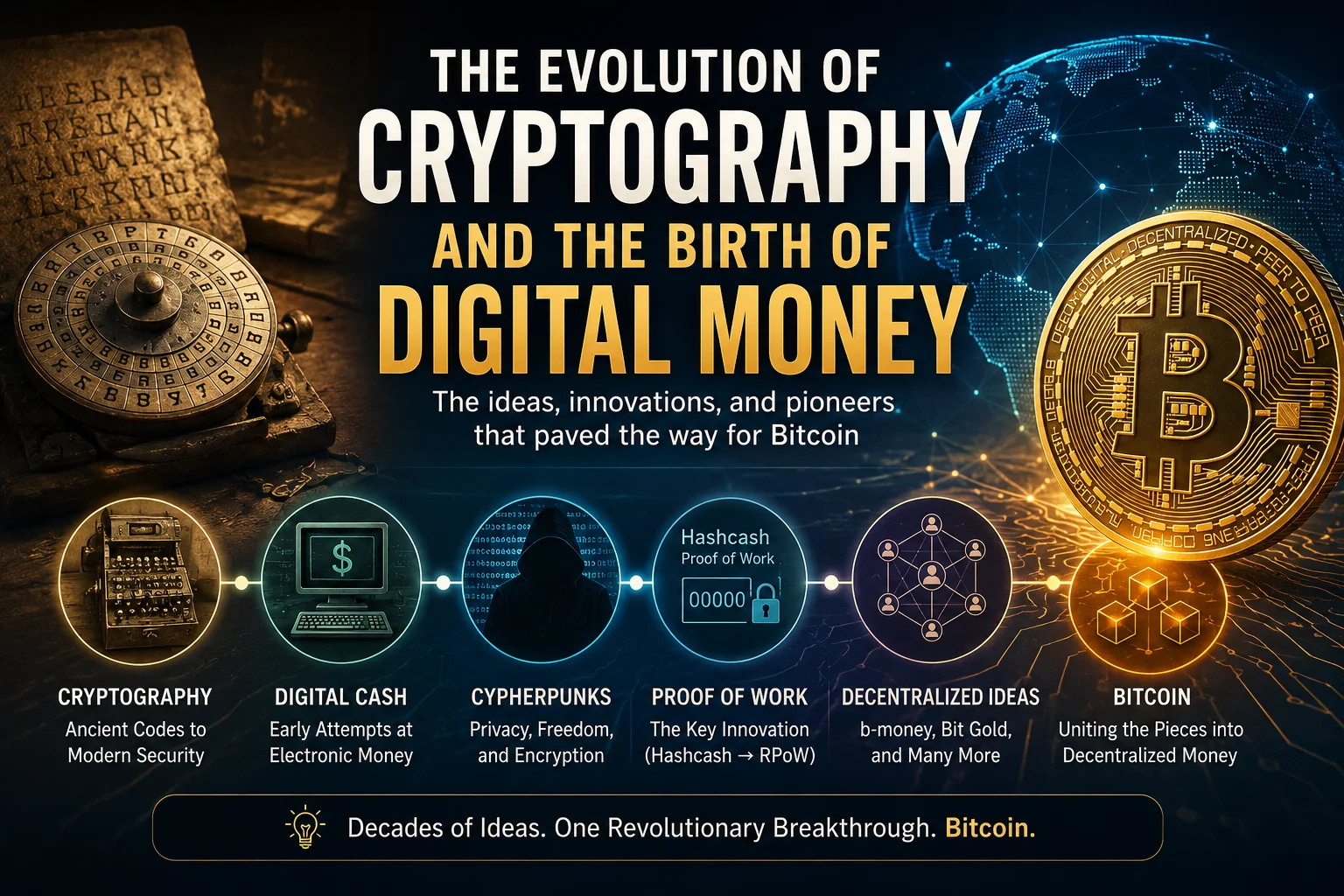
Before Bitcoin became the world’s first successful decentralized cryptocurrency, decades of cryptographic research, digital cash experiments and privacy-focused ideas created the foundation for modern blockchain technology.
Quick Facts
Why This Topic Matters
Bitcoin is often described as a sudden breakthrough, but that description misses the deeper story. Bitcoin was not created in isolation. It was the result of decades of experimentation in cryptography, electronic cash, distributed systems and online privacy.
Long before the Bitcoin white paper was published in 2008, researchers had already been asking one of the most important questions in financial technology: can money exist digitally without relying on a bank, government or payment company?
The answer was difficult because digital information is easy to copy. A photo, document or file can be duplicated endlessly at almost no cost. Money, however, cannot work that way. If one digital coin can be copied and spent multiple times, it cannot function as reliable money.
This challenge eventually became known as the double-spending problem. Solving it without a central authority was one of the core achievements that made Bitcoin historic.
What Is Cryptography?
Cryptography is the science of protecting information through mathematical techniques. In simple terms, it allows people to send, store and verify information securely even when others may try to intercept, copy or manipulate it.
Ancient forms of cryptography were used to hide military or diplomatic messages. These early systems were often based on simple substitutions or rearrangements of letters. Modern cryptography became far more powerful with the rise of computers.
Instead of simple codes, modern systems use advanced mathematics, large numbers, hash functions and public-private key pairs. These tools make it possible to verify identity, sign digital messages and protect online transactions.
Today, cryptography protects online banking, credit card payments, password systems, secure websites, digital signatures and cryptocurrency wallets. Without cryptography, Bitcoin could not exist.
The Internet and the Double-Spending Problem
When the Internet began expanding in the late twentieth century, it transformed the way people exchanged information. Messages, images, software and documents could move across the world instantly. Naturally, many researchers wondered whether money could also become fully digital.
But digital money faced a unique problem. If money becomes just another digital file, what stops someone from copying it? If Alice sends a digital coin to Bob, she might also copy the same coin and send it to Charlie. This would destroy trust in the system.
Traditional payment systems solve this by using trusted intermediaries. Banks, credit card networks and payment processors maintain ledgers that decide which transactions are valid.
The challenge for decentralized digital money was much harder: how can a network of strangers agree on who owns what without trusting a central database?
The Cypherpunk Movement
The Cypherpunk movement was one of the most important cultural and technical foundations behind Bitcoin. In the late 1980s and 1990s, cypherpunks believed that privacy should be protected through cryptography rather than only through laws or institutions.
Their central idea was simple but powerful: individuals should be able to communicate, transact and store information privately in a digital world. As the Internet grew, cypherpunks worried that governments and corporations would gain unprecedented power to monitor personal activity.
Instead of waiting for legal protections, they promoted practical tools. Encryption, anonymous remailers, digital signatures and electronic cash were discussed as ways to give individuals more control over their own information.
Many ideas later associated with cryptocurrency were actively discussed in cypherpunk communities long before Bitcoin existed. These included private digital payments, decentralized systems, cryptographic identity and resistance to censorship.
DigiCash and Early Digital Cash
One of the earliest serious attempts to create digital money came from cryptographer David Chaum. In the 1980s, Chaum developed ideas around anonymous digital payments and later founded DigiCash, a company that attempted to bring cryptographic electronic cash to the real world.
DigiCash used advanced cryptographic techniques to allow digital payments with strong privacy features. In many ways, it was far ahead of its time. It showed that money could be represented electronically and transferred using cryptographic signatures.
However, DigiCash still depended on a central company and cooperating banks. This meant it was not truly decentralized. If the company failed or banks refused to participate, the system could not survive independently.
DigiCash eventually disappeared, but its historical importance remains enormous. It proved that digital cash was technically possible, while also revealing the weakness of systems that depend too heavily on a central operator.
Hashcash and Proof of Work
In 1997, Adam Back introduced Hashcash as a system for reducing email spam and denial-of-service attacks. Hashcash was not originally designed to be money. Its purpose was to make large-scale abuse expensive by requiring computers to perform a small amount of computational work.
The basic idea was elegant. Before sending an email, a computer would need to solve a mathematical puzzle. For an ordinary user sending a few messages, this cost was small. For a spammer trying to send millions of messages, the total cost became significant.
This concept later became known as Proof of Work. Bitcoin adapted the idea in a much more powerful way. Instead of using computational work to discourage spam, Bitcoin uses it to secure a public ledger and select which miner can add the next block of transactions.
Hashcash is one of the clearest direct ancestors of Bitcoin mining. The mining process in Bitcoin can be understood as a large-scale, economically incentivized version of Proof of Work.
b-money, Bit Gold and RPoW
After DigiCash and Hashcash, several proposals came even closer to the design of Bitcoin. Among the most important were b-money by Wei Dai, Bit Gold by Nick Szabo and Reusable Proof of Work by Hal Finney.
b-money by Wei Dai
In 1998, Wei Dai proposed b-money, a decentralized digital money concept. b-money described a system where participants could maintain balances and contracts without relying on a central authority.
Although b-money was never fully implemented, it introduced ideas that strongly resemble later cryptocurrency systems. These included distributed recordkeeping, digital identities and peer-to-peer value transfer.
Bit Gold by Nick Szabo
Around the same period, Nick Szabo proposed Bit Gold. Bit Gold attempted to create scarce digital objects using computational work, timestamps and public verification.
Bit Gold is often viewed as one of the closest conceptual predecessors to Bitcoin. It included many familiar ideas: Proof of Work, digital scarcity, time-stamped records and a chain-like structure of validated data.
Reusable Proof of Work by Hal Finney
In 2004, Hal Finney introduced Reusable Proof of Work, often shortened to RPoW. This system allowed Proof-of-Work tokens to be reused and transferred rather than simply being consumed once.
RPoW represented another major step toward digital currency. It connected computational work with transferable digital value, moving closer to what cryptocurrencies would later become.
Major Pre-Bitcoin Digital Money Experiments
How Bitcoin Unified the Pieces
Bitcoin’s breakthrough was not that it invented every component from scratch. Its true achievement was combining several existing ideas into one working decentralized system.
Satoshi Nakamoto brought together public-key cryptography, digital signatures, hash functions, Proof of Work, peer-to-peer networking, economic incentives and a public transaction ledger. Each piece already had a history, but Bitcoin connected them in a way that finally solved the decentralized digital money problem.
The Bitcoin blockchain allowed a global network of participants to agree on the order of transactions without a central operator. Miners competed to perform Proof of Work, and the longest valid chain became the shared history of the network.
This design solved the double-spending problem in a decentralized way. Instead of trusting a bank to decide which transactions were valid, users could verify the blockchain themselves.
Why This History Still Matters
The history of cryptography and digital money is not only a story about Bitcoin. It explains the foundation of the entire cryptocurrency industry.
Ethereum, stablecoins, privacy coins, decentralized finance, hardware wallets, smart contracts and layer-2 networks all depend on cryptographic principles. Even when a project does not use Bitcoin’s exact design, it still builds on the broader legacy of secure digital ownership and verification.
Understanding this background also helps beginners avoid a common mistake: thinking that cryptocurrency is simply a speculative asset class. While speculation is part of the market, the deeper innovation is the ability to create, transfer and verify digital value without relying entirely on centralized intermediaries.
From DigiCash to Hashcash, from b-money to Bit Gold, and from RPoW to Bitcoin, each step helped reveal what decentralized digital money needed in order to survive.
Key Takeaways
Cryptography made secure digital communication and digital signatures possible. The Internet created a need for native digital money, but the double-spending problem made decentralized digital currency extremely difficult.
Cypherpunks promoted privacy, encryption and decentralized systems. DigiCash, Hashcash, b-money, Bit Gold and RPoW each contributed important ideas. Bitcoin succeeded by combining these ideas into a decentralized, incentive-driven network.
FAQ
Did digital money exist before Bitcoin?
Yes. Several digital money experiments existed before Bitcoin, including DigiCash, b-money, Bit Gold and RPoW. However, Bitcoin was the first successful decentralized digital currency to operate without a central company, bank or administrator.
Why was the double-spending problem so important?
Digital data can be copied easily. For digital money to work, the system must prevent the same unit of value from being spent more than once. Bitcoin solved this problem through a public blockchain, Proof of Work and decentralized consensus.
What role did cryptography play in Bitcoin?
Cryptography allows Bitcoin users to prove ownership, sign transactions, secure wallets and verify the integrity of blocks. Public-key cryptography, digital signatures and hash functions are essential to Bitcoin’s design.
Was Bitcoin based on Hashcash?
Bitcoin did not simply copy Hashcash, but it used the Proof-of-Work concept that Hashcash helped popularize. Bitcoin adapted this idea to secure a decentralized ledger and create a competitive mining system.
Why did earlier digital cash systems fail?
Many earlier systems depended on central companies, banks or trusted servers. Others remained theoretical and were never fully implemented. Bitcoin succeeded because it combined cryptography, incentives, peer-to-peer networking and decentralized consensus.